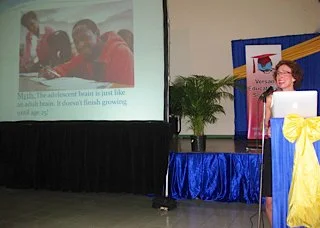
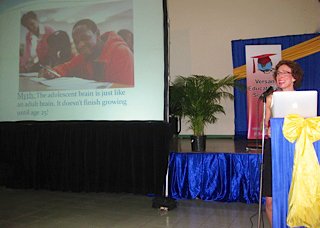
Last month, I had the great privilege to travel to Jamaica to present my talk, “What were you thinking? Understanding the Teen Brain,”at the “Recession-Proofing Your Education” Conferences in Kingston and Montego Bay sponsored by Versan Educational Services. Versan is an international educational organization that advises, places and trains students for boarding schools and colleges around the world. Ms. Sandra Bramwell, the founder and director, is one of the most energetic, eloquent and kind-hearted women whom I have ever met. She is also a visionary. The conferences were attended by over 175 parents, teens and guidance counselors as well as radio stations.
  Each time I give this talk, I am always curious what the audience members will find most interesting and relevant to their lives. Sometimes people are curious about the recent findings in brain research that the pre-frontal cortex continues to develop until the mid-twenties. Sometimes people are interested in learning more about teens and sleep. And sometimes, people would just like to what is ‘normal’ teen behavior and what is not. At both of my talks in Jamaica, the attendees were especially interested by two issues that are related to executive functioning skills. 1. A 2011 NIMH-funded study about emotional recognition found that adolescents showed a 50% accuracy of correctly naming emotions versus the adults in the study who showed 100% accuracy. This finding means that adolescents misinterpreted the facial expressions that they were shown in half the cases. When I emphasized that this result implies that teens are reading situations incorrectly about half of the time and then responding to that misreading, people were amused but also concerned. We talked about how understanding facial expressions correctly relies on executive functioning skills which are still developing. Teens wondered if they could speed up the course of development. “Miss,” on young man asked, “Is there any way to speed up the development process if I work really hard? I would like it to be finished by the time I am 20, not 25.” “Well,” I said, “You can work hard on strengthening your executive functioning skills like planning, organizing, judgment and self-awareness but your brain will grow at its own rate and you can’t really make that go any faster.” He was visibly disappointed.
  2. Time management: I talked about backwards design, which seemed to be a new concept. We looked at how challenging it can be to get ready and out of the house on time for school in the morning. With the eager participation of one mother and daughter, we traced their morning routine as it unfolds now with all of its bumps and then rearranged it by going backwards from the time of arrival at school. The audience found this technique very useful. I really appreciated the frank feedback that the Jamaicans gave right after my talk—“I liked the part about learning how to make better decisions but not so much about the brain cells”—and their warmth and humor. It was refreshing (and a bit comforting) to see that parents and teens in the Caribbean have many of the same questions and concerns that we have here in the USA.



 Parents and teachers often complain to me that kids with ADHD don’t remember things they are told. This forgetfulness happens for a number of reasons—poor working memory, internal or external distractions, limited ability to sequence information into steps, anxiety about forgetting—and changing how you talk to a child or teen with ADHD can improve memory. When you are asking someone with ADHD to do something, that request should only have one component. The chances of him or her remembering more than one thing at a time are very slim, even with the aide of medication. So, keep your task SIMPLE. The rule of three is critical to successfully making these changes. 1. Say the youngster’s name. 2. Look directly at him/her AT EYE LEVEL, making sure your gaze is returned and held. 3. State your task clearly and calmly. Ask the child or teen to repeat your request EXACTLY and then, ask for a second repetition. These three steps have to be followed in this sequence in order for them to work most effectively. They activate several ways for connecting—sight, sound, repetition–that trigger different and simultaneous neural pathways. When the single task is completed, then you can give another one in exactly the same manner. Communicating in this easy, direct manner improves the likelihood that the task is remembered and completed. Everyone will be less frustrated and feel more confident that things actually get done!


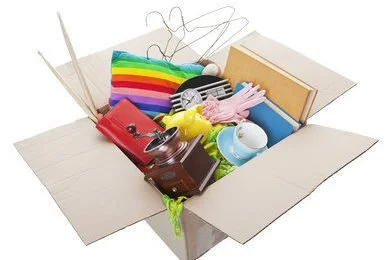
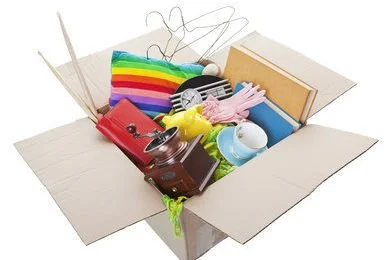
 As the trees and flowers begin to bloom, many parents take a look around their homes and long to clean out the family nest. Sometimes, the task seems just too overwhelming and you don’t get any further than a big sigh. At other times, you start with the best intentions but can’t get past the battles about what to keep and what to get rid of. Here are some simple steps that you can use to organize the belongings of your children or teens this spring (and maybe even your own)! The path to organizing success involves the 3 P’s: patience, perseverance and practice. It requires a sense of humor and the ability to keep focused on your goal. Improve collaboration with your son or daughter and avoid power struggles by using the following steps:
  1. Choose your target carefully. Make it manageable and give it a specific period of time. For example, go for cleaning out JUST the closet and give yourself a limit of around an hour. Or, concentrate on picking things off the floor and do the closet on a different day. Keep track of the time so you don’t run out! 2. Engage your child or teen in the process, using incentives. This means offering your child or teen something s/he may want to do as a reward for working with you on this project. Examples may include extra screen time (tv or computer or gaming systems), fun activity (biking, board games, playing sports), time with friends or a special food treat. 3. Get 4 bags and label each one: “keep”, “trash”, “give away”, “unsure”. Divide the STUFF into these bags. If your child or teen has trouble with letting go of belongings, help him or her make choices by talking about what is really being used and how someone else might want what your son or daughter does not. When you have your 4 bags, go through the “unsure” bag carefully one more time, putting its contents in the other 3 bags. Then put away the “keep” items immediately and deal with the “trash” and “give away” bags. Remember it is critical to value what you have done together. Look at your accomplishment and congratulate yourselves on the success of your efforts!!